.png)
On Cloudflare's Q2 2026 earnings call, management confirmed a milestone: non-human, agentic traffic has crossed 50% of total network traffic, with daily AI agent requests up 1,700% year-over-year (measured June 2025–May 2026). CEO Matthew Prince had originally forecast bots would overtake human traffic by 2027; it happened faster than even his own models expected.
This isn't just a web-scraping or LLM-inference story. It's an imminent bottleneck for global financial infrastructure.
The Arithmetic of Machine-to-Machine Commerce
Consider the baseline: Cloudflare processes roughly 500 million requests per second. If just 1–10% of that traffic involves automated API metering, data queries, or agentic micro-services monetized in fractions of a cent, the web needs 10 million to 100 million transactions per second (TPS) of payment capacity.
For scale: Visa's commonly cited "peak" figure is ~80,000 TPS, though that's theoretical capacity; its actual average throughput runs closer to 1,700–8,500 TPS. ACH, SWIFT, and FedNow batch and settle in hours to days, with cost structures that make sub-cent transactions uneconomical. Even the fastest public blockchains today (Solana running ~3,600 TPS live, Monad and MegaETH targeting 10,000 to 100,000+ TPS) sit one to three orders of magnitude below the 10M+ ceiling agentic traffic implies, and still face latency spikes and fee volatility under sustained bot load.
Legacy card networks and first-generation Web3 rails were built for human workflows: manual authorizations, fixed interchange fees, single-signature transactions. AI agents don't work that way. They're hyper-rational, fee-sensitive, sub-second execution engines optimizing for raw unit economics.
The Architectural Dilemma: Netting Layers vs. Specialized Chains
No single monolithic network can serve every agentic workload, so the ecosystem is bifurcating into specialized architectures, each solving a different piece of the puzzle: execution speed, wallet/permission friction, or micro-unit economics.
1. Commerce & account abstraction: Base (Ethereum L2). Session Keys and ERC-4337/7702 let humans set programmable spending boundaries (e.g., a $100/day allowance) so agents transact autonomously within limits, using tools like Coinbase AgentKit.
2. High-frequency micro-transactions: Solana. Sub-400ms finality and sub-$0.01 fees, paired with agent frameworks like elizaOS, make it the default rail for real-time API metering and data-feed purchasing.
3. Parallelized execution: Monad. Concurrent (not sequential) transaction processing stops one congested bot swarm from spiking gas fees for everyone, which matters for continuous agent-to-agent metering rather than discrete human transactions.
4. Ultra-scale settlement: MegaETH & centralized netting. For Cloudflare-scale volume, specialized rollups and off-chain netting aggregate millions of micro-actions before settling net balances on-chain periodically.
Figure 1: Agentic-Payment Rails vs. a Trading-Venue Benchmark
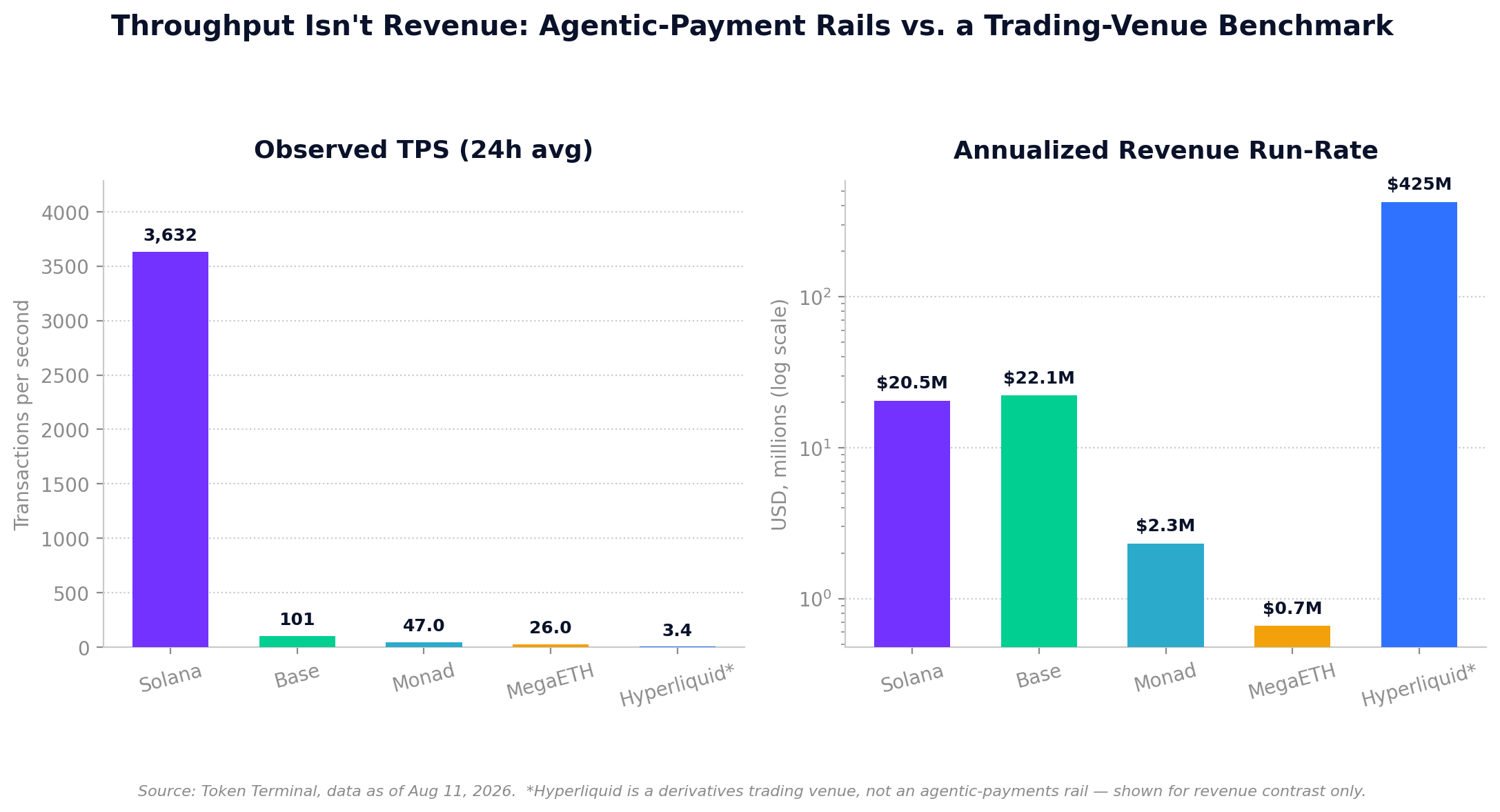
Worth a caveat on the chart above: Hyperliquid isn't an agentic-payments rail; it's a specialized derivatives trading venue. It's included deliberately as a contrast point. It processes the fewest transactions per second of the group yet generates the most revenue by far, because each transaction carries far more economic weight. That's the broader lesson for machine-economy infrastructure: throughput and revenue capture are two different games, and app-chains that route protocol fees into real yield (as Hyperliquid does via buybacks) can out-earn high-throughput rails without competing on TPS at all.
Figure 2: Cost Efficiency for Agentic Micropayments
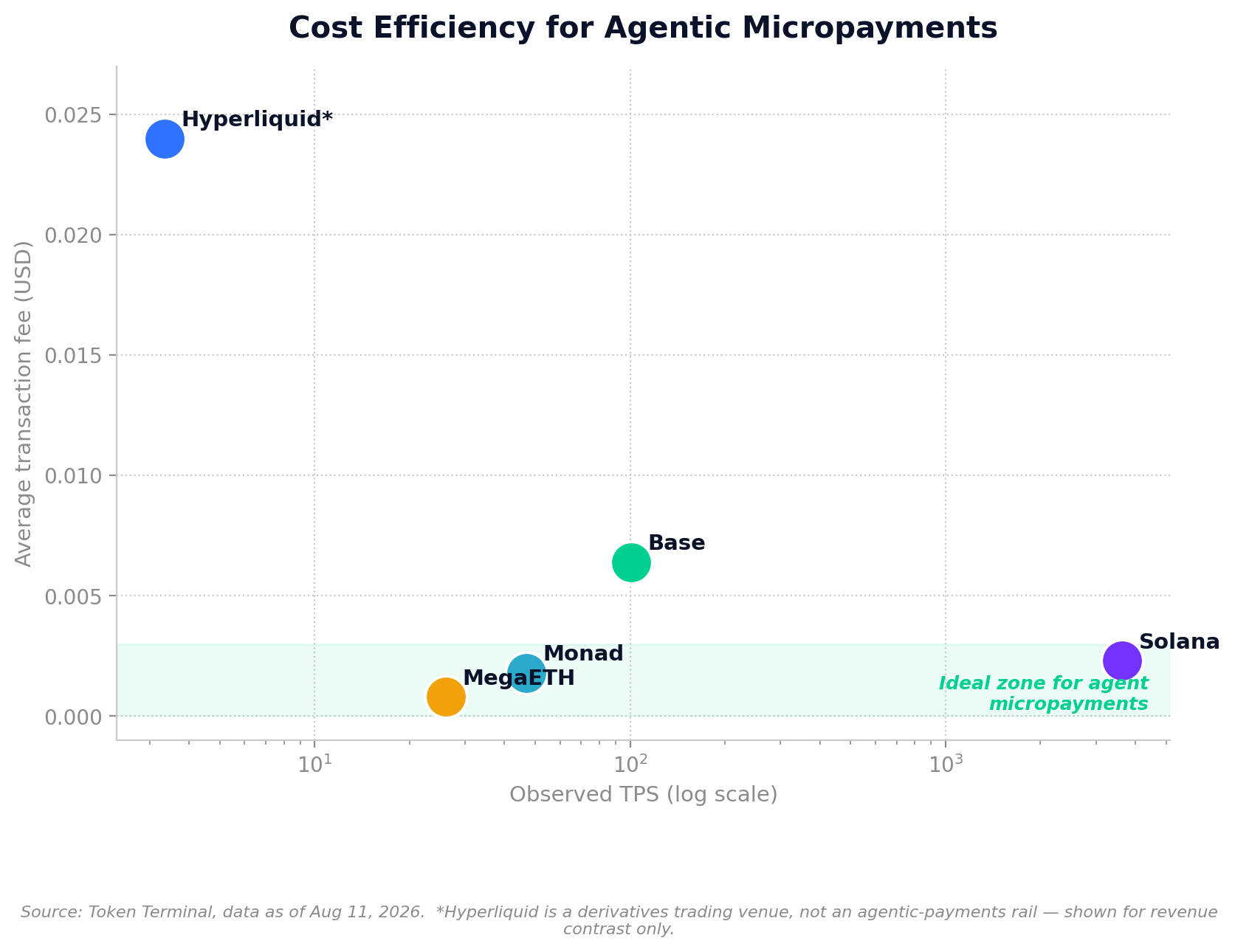
MegaETH and Monad currently post the lowest per-transaction costs (sub-$0.002), which is what makes agent-scale micro-invoicing arithmetic actually work.
The Paradigm Shift for Capital & Infrastructure
For founders, asset managers, and infrastructure architects, this changes the value-capture framework:
- SaaS pricing is obsolescent. Seat-license subscriptions give way to real-time, pay-per-execution micro-invoicing that agents settle directly.
- Tokenomics must adapt. Models built on narrative momentum or governance theater fail under machine traffic; value accrues to real-yield mechanisms: fee buybacks (protocol revenue funds token purchases), solver-auction economics (third parties bid to fill agent orders, protocol earns the spread), and SLA-staked bonds (infrastructure operators post collateral that's slashed automatically if they underperform).
- Stablecoins become the native currency of AI. Sub-cent, programmable USDC/USDT settlement is emerging as the default machine-to-machine value layer.
As non-human traffic keeps compounding, the winners of the next decade's financial infrastructure won't just build faster rails for humans; they'll build the settlement layer for the machine economy.
About the Author(s):
Martin Leinweber leads digital asset research and strategy at MarketVector Indexes, where he develops index products, publishes institutional research, and serves as the firm's primary voice on crypto markets to a global client base. His work sits at the intersection of systematic investing and an emerging asset class, translating rigorous quantitative frameworks into actionable insight for institutional investors. Before joining MarketVector, Martin spent nearly two decades as a Portfolio Manager across equities, fixed income, and alternative investments. At Quoniam Asset Management, one of Germany's foremost quantitative houses, he managed active funds for institutional clients including insurance companies, pension funds, and sovereign wealth funds. Earlier in his career at MEAG, the asset manager of Munich Re and ERGO, he contributed to the firm's international expansion, including the establishment of a joint venture with PICC, China's largest insurance company, with operations in Shanghai and Beijing. Martin is co-author of two Wiley publications: Asset-Allokation mit Kryptoassets: Das Handbuch (2021), the first institutional handbook on integrating digital assets into traditional portfolios, and Mastering Crypto Assets: Investing in Bitcoin, Ethereum, and Beyond (2024). He holds a Master of Economics from the University of Hohenheim and is a CFA Charterholder.
For informational and advertising purposes only. The views and opinions expressed are those of the authors but not necessarily those of MarketVector Indexes GmbH. Opinions are current as of the publication date and are subject to change with market conditions. Certain statements contained herein may constitute projections, forecasts, and other forward-looking statements that do not reflect actual results. It is not possible to invest directly in an index. Exposure to an asset class represented by an index is available through investable instruments based on that index. MarketVector Indexes GmbH does not sponsor, endorse, sell, promote, or manage any investment fund or other investment vehicle that is offered by third parties and that seeks to provide an investment return based on the performance of any index. The inclusion of a security within an index is not a recommendation by MarketVector Indexes GmbH to buy, sell, or hold such security, nor is it considered to be investment advice.
Get the latest news & insights from MarketVector
Get the newsletterRelated:
Most popular
-
 Commentary
How Rising Rates Can Impact Equity Returns
-
 Commentary
The Space Economy Is Taking Off