
Google's March 2026 research moved the quantum timeline forward. The estimated hardware threshold for breaking elliptic curve cryptography dropped roughly twentyfold, and around 6.9 million BTC currently sits in addresses that would be potentially exposed to a quantum-capable attacker.
The risk for ETF issuers, though, isn't really the cryptography. It's the fork that would follow any credible quantum threat — and the operational, legal, and valuation consequences that fork would create for custodians, index methodologies, and NAV processes.
That's why we treat quantum preparedness as a core responsibility, not a watch item.
MarketVector's quantum readiness program
As the provider of reference rates and index methodologies underpinning institutional digital asset products, we regard quantum preparedness as a core responsibility. Three workstreams are active.
Reviewing index guide provisions
We are conducting a comprehensive review of our index guide provisions related to forks and extraordinary events. The MarketVector Bitcoin Benchmark Rate (BBR) and our broader digital asset index suite already contain fork-handling rules and discretion frameworks developed in accordance with IOSCO Principles for Financial Benchmarks. We are evaluating whether these provisions need supplemental language for quantum-specific scenarios — including multi-fork fragmentation, cryptographic compromise of the underlying protocol, and the impact of large-scale wallet vulnerability on circulating supply calculations.
Building a fork observation framework for a post-quantum Bitcoin
We are developing an internal fork observation framework with explicit criteria for identifying the dominant chain in a post-quantum fork scenario. The framework draws on the five-signal model in our paper: hash rate migration, exchange support, developer alignment, custodian adoption, and regulatory treatment. The objective is simple — if a quantum-driven fork occurs, our response should be governed by a pre-established, transparent process rather than ad hoc judgment.
Exhibit 1: Bitcoin market cap dominance, Jan 2017 - June 2018. BTC dominance fell from 96% to ~37% during the BCH fork window. A quantum-driven fork could trigger comparable - or more severe - dominance compression.
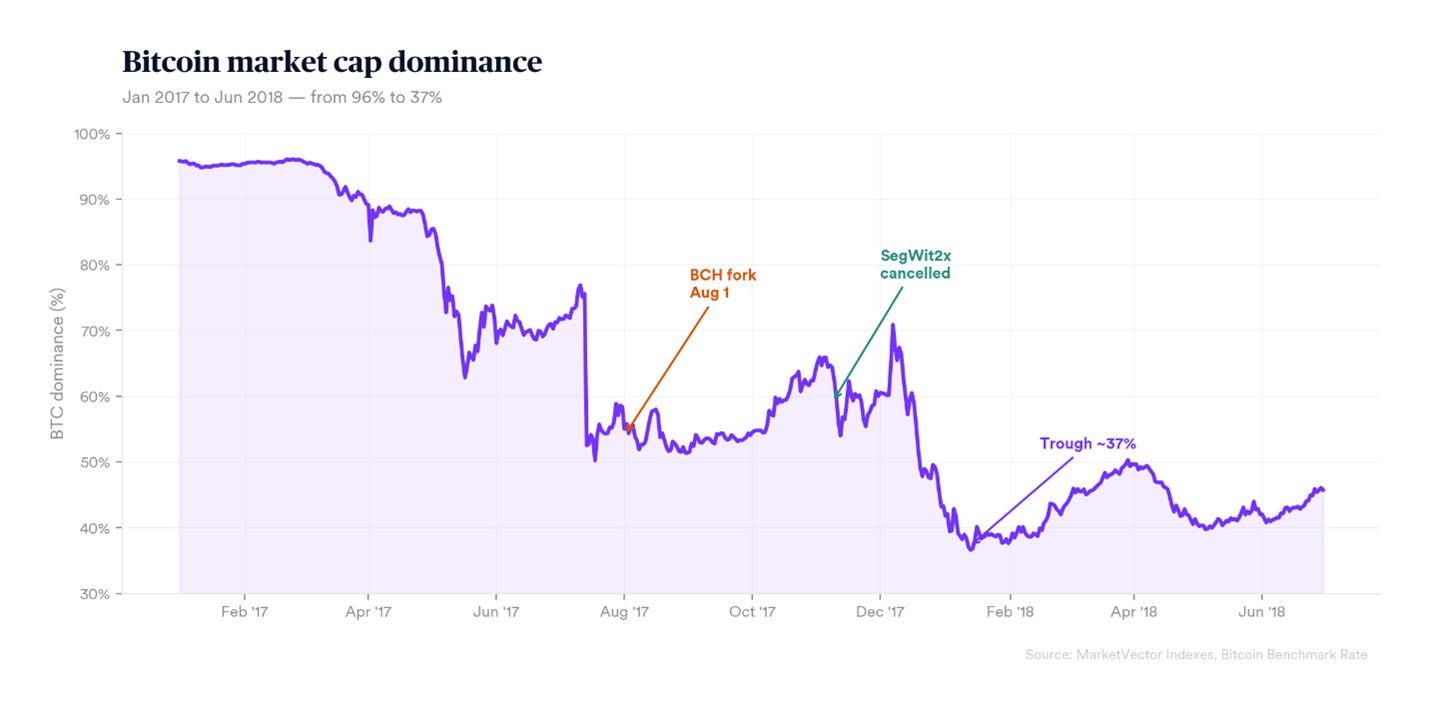
Source: MarketVector. Bitcoin Benchmark Rate index. Data as of June 2018.
Monitoring BIP-360 and competing post-quantum Bitcoin proposals
We are tracking BIP-360 and related proposals as part of our ongoing index maintenance obligations, with internal resources assigned to the Bitcoin development mailing list and relevant GitHub repositories. Material developments will be assessed for their implications on our index methodologies and communicated to licensees as appropriate.
What this means for ETF issuers and licensees
We do not believe the quantum threat requires immediate changes to our index calculations or constituent definitions. What it does require is a documented framework for responding when and if the threat materializes. We intend to be transparent with our clients about both the risks we see and the preparations we are making.
Read the full paper
Read the full paper: The Quantum Clock Is Ticking — What ETF Issuers Need to Do Before Q-Day for the complete analysis, including the five-signal fork framework, the 2017 block size war as a reference case, and a detailed agenda for ETF issuer due diligence.
About the Author(s):
Martin Leinweber leads digital asset research and strategy at MarketVector Indexes, where he develops index products, publishes institutional research, and serves as the firm's primary voice on crypto markets to a global client base. His work sits at the intersection of systematic investing and an emerging asset class, translating rigorous quantitative frameworks into actionable insight for institutional investors. Before joining MarketVector, Martin spent nearly two decades as a Portfolio Manager across equities, fixed income, and alternative investments. At Quoniam Asset Management, one of Germany's foremost quantitative houses, he managed active funds for institutional clients including insurance companies, pension funds, and sovereign wealth funds. Earlier in his career at MEAG, the asset manager of Munich Re and ERGO, he contributed to the firm's international expansion, including the establishment of a joint venture with PICC, China's largest insurance company, with operations in Shanghai and Beijing. Martin is co-author of two Wiley publications: Asset-Allokation mit Kryptoassets: Das Handbuch (2021), the first institutional handbook on integrating digital assets into traditional portfolios, and Mastering Crypto Assets: Investing in Bitcoin, Ethereum, and Beyond (2024). He holds a Master of Economics from the University of Hohenheim and is a CFA Charterholder.
For informational and advertising purposes only. The views and opinions expressed are those of the authors but not necessarily those of MarketVector Indexes GmbH. Opinions are current as of the publication date and are subject to change with market conditions. Certain statements contained herein may constitute projections, forecasts, and other forward-looking statements that do not reflect actual results. It is not possible to invest directly in an index. Exposure to an asset class represented by an index is available through investable instruments based on that index. MarketVector Indexes GmbH does not sponsor, endorse, sell, promote, or manage any investment fund or other investment vehicle that is offered by third parties and that seeks to provide an investment return based on the performance of any index. The inclusion of a security within an index is not a recommendation by MarketVector Indexes GmbH to buy, sell, or hold such security, nor is it considered to be investment advice.
Get the latest news & insights from MarketVector
Get the newsletterRelated:
Most popular
-
 Commentary
How Rising Rates Can Impact Equity Returns
-
 Commentary
The Space Economy Is Taking Off