Space Oddity? Not anymore.
Last week was World Space Week 2026, celebrated every year and observed this time in more than 100 nations. This year’s theme, ‘Rocket Revolution,’ felt especially timely. On October 8th, NASA’s SpaceX Crew-12 mission returned to Earth, landing in the Pacific Ocean after 237 days in orbit and bringing home an international crew from NASA, ESA, and Roscosmos. A day later, Northrop Grumman’s Cygnus XL cargo spacecraft departed the International Space Station.
Not long ago, space was the domain of national space agencies. Today, companies build launch systems, satellites, and networks that move crews and cargo, deliver communications, and image the planet. The industry now spans launch providers, satellite communications, direct-to-device connectivity, earth observation, and in-orbit services.
That shift is changing how space is represented in public markets. MarketVector’s four Space Indexes track different segments of this evolving industry, from focused space companies to broader global benchmarks, and since launches are kind of our thing, it seemed like the right week to take a closer look.
Index Performance ending October 13, 2026
Index Name |
Symbol |
1M |
6M |
YTD |
1Y |
3Y |
Inception |
|---|---|---|---|---|---|---|---|
MVWARP |
-2.66% |
-20.11% |
12.53% |
9.43% |
205.48% |
68.67% |
|
MVSPC |
-4.68% |
-21.36% |
12.81% |
13.97% |
255.11% |
265.70% |
|
MVSPX |
-4.07% |
-19.55% |
6.15% |
7.11% |
176.20% |
83.28% |
|
BCNCT |
2.33% |
15.81% |
36.78% |
36.06% |
176.93% |
360.86% |
Source: MarketVector Indexes, data as of October 13, 2026
After a strong run earlier in the year, three of the four space indexes declined over the past six months, though all four remain positive year-to-date. Sentiment toward space stocks has shifted at times. In July, Reuters reported that SpaceX shares had fallen below their IPO price for the first time, with analysts pointing to profit-taking and a reassessment of valuations.
The BlueStar® Space and Connective Technologies Index (BCNCT) moved in the opposite direction, gaining 15.81% over six months and 36.78% year-to-date. This may be in part related to BlueStar index’s broader exposure to connective technologies, including 5G networks, semiconductors and data transmission. Information Technology accounts for around 75% of its sector weighting, giving it greater exposure to technology-driven performance trends beyond the space sector alone.
Rocket Man Isn’t the Whole Show
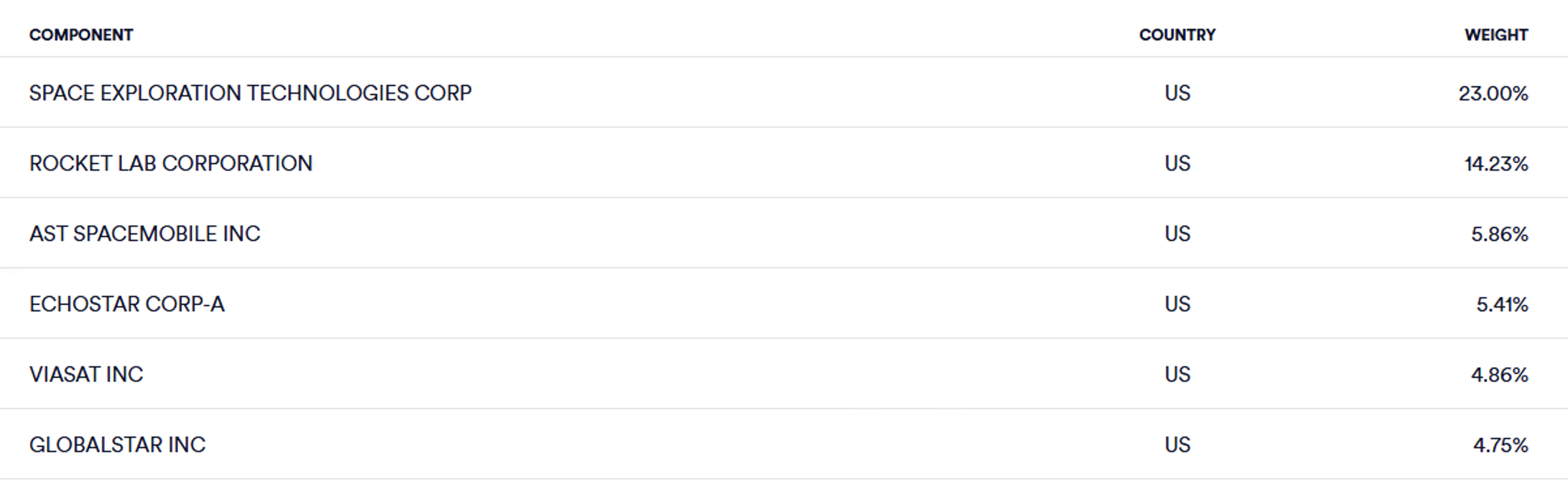
SpaceX might be the most recognizable name in the sector, but the industry reaches well past a single company. The MarketVector™ Space Index (MVWARP) offers a focused view of companies with substantial exposure to space-related activities. Its largest weights show how the theme is built.
MVWARP top components
Source: MarketVector Indexes, data as of October 13, 2026
SpaceX and Rocket Lab together account for roughly 37% of the index. Both provide launch services, but their businesses extend beyond getting payloads into orbit. SpaceX operates its Starlink satellite network, while Rocket Lab also develops spacecraft and satellite components. The broader story is what happens before, during, and after launch, from building space infrastructure to enabling communications and collecting data.
Why Satellites Are Having a Moment
Year-to-date, satellite communications companies have been among the strongest performers in MVWARP, led by constituents Iridium Communications (+181.74%) and Viasat (+105.66%). A few themes have shaped the sector this year:
- Direct-to-device connectivity: Companies such as AST SpaceMobile and Iridium are developing satellite networks designed to extend connectivity to smartphones, including areas with limited cellular coverage.
- Consolidation and spectrum deals: Acquisitions and spectrum agreements are highlighting the value of radio frequencies used for satellite and mobile communications, while reshaping competition across the sector.
- Defense and government demand: Government agencies, including the U.S. Space Force, continue to drive demand for secure satellite communications, supporting long-term contracts for some providers.
Reusable rockets have helped lower launch costs, making satellite broadband more viable across applications such as aviation, shipping and logistics. Industry analysis of reusable rocket technology discusses how advances in rocket recovery contribute to these cost reductions.
Four Indexes, Different Views of Space
Space exposure is not one-size-fits-all, and the MarketVector family reflects that:
- MarketVector™ Space Index (MVWARP): A focused, 20-stock index of pure-play companies with at least 50% of revenue from qualifying space-related activities.
- MarketVector™ Space Industry Index (MVSPX): A broader benchmark targeting 90% free-float market-cap coverage of the listed space industry, with at least 25 components.
- MarketVector™ Global Space Industry Screened Index (MVSPC): A global space-industry benchmark that applies ESG-related exclusions.
- BlueStar® Space and Connective Technologies Index (BCNCT): A modified market-cap-weighted index of the US-listed companies that provide hardware, software or services for 5G and 6G networks and other connective technologies, or that are involved in satellite communications and the space industry.
A Revolution, Launched
Rocket revolutions start with a launch, but the story doesn’t end there. As the space economy continues to expand commercially, companies are developing new capabilities across communications, Earth observation, infrastructure, and orbital services.
The countdown is over. The space economy is already in orbit.
For more information on MarketVector Indexes, visit www.marketvector.com
About the Author(s):
Nolan Borders is a 2026 intern at MarketVectorTM Indexes based in New York City. Nolan is currently a Business Administration major with a concentration in Marketing and a minor in Psychology at Marist University.
For informational and advertising purposes only. The views and opinions expressed are those of the authors but not necessarily those of MarketVector Indexes GmbH. Opinions are current as of the publication date and are subject to change with market conditions. Certain statements contained herein may constitute projections, forecasts, and other forward-looking statements that do not reflect actual results. It is not possible to invest directly in an index. Exposure to an asset class represented by an index is available through investable instruments based on that index. MarketVector Indexes GmbH does not sponsor, endorse, sell, promote, or manage any investment fund or other investment vehicle that is offered by third parties and that seeks to provide an investment return based on the performance of any index. The inclusion of a security within an index is not a recommendation by MarketVector Indexes GmbH to buy, sell, or hold such security, nor is it considered to be investment advice.
Get the latest news & insights from MarketVector
Get the newsletterRelated:
Most popular
-
 Commentary
The Space Economy Is Taking Off
-
 Commentary
Hidden Gems: Nigeria