
The One Line That Matters
The most important part of Robinhood’s onchain push is not that it launched another crypto product. It is that Robinhood is beginning to look less like a brokerage that offers crypto, and more like a financial platform that uses crypto infrastructure as its operating system.
Executive Summary
A brokerage stopped renting its rails and started owning them
On 1 July 2026, at an event in London titled The World is Flat, Robinhood switched on the public mainnet of its own blockchain and wired a decentralized exchange directly into its wallet. Read quickly, it looks like a crypto feature drop. Read properly, it is the clearest signal yet that the machinery of retail finance is moving onchain, and that the companies which own both the customer and the rails will capture the economics of that shift.
Three moves define the announcement. First, Robinhood Chain, an Ethereum Layer 2 built on Arbitrum’s technology, went live as the settlement layer for tokenized stocks, stablecoins, and onchain lending. Second, Lighter, a fast decentralized derivatives venue, became the native engine for perpetual futures inside the Robinhood Wallet. Third, tokenized versions of household stocks such as Nvidia, Apple, and Tesla went live for round-the-clock trading across more than 120 countries. Taken together, they turn a place people bought shares into a place where value is issued, traded, lent, and settled on infrastructure Robinhood controls.
The early numbers are loud. In its first nine days the network processed more than 18 million transactions across over 350,000 wallets, cleared roughly 1.2 billion US dollars of on-exchange volume, and gathered about 250 million dollars of value into its DeFi applications. Fees crossed 100,000 dollars at a gross margin near 99 percent. Those are small absolute figures against Robinhood’s brokerage, and they arrived during a crypto bear market, which is precisely why the trajectory, not the level, is the story.
18m+ transactions in the first nine days |
$1.2b on-exchange trading volume, launch window |
~99% gross margin on network fees |
224k monthly active wallets by early July |
|---|
Sources: Token Terminal; Robinhood; launch-week reporting. Figures are early-stage and should be read as trajectory rather than run-rate.a
For the MarketVector™ Tokenization Technology Leaders Index (MVTKNQ), this is not a headline to react to. It is the thesis, arriving on schedule.
Robinhood and Coinbase are both constituents of MVTKNQ, alongside the infrastructure and digital-asset exposures that make tokenization work. The index was designed to hold exactly the companies now writing this playbook. In the sections that follow we explain the plumbing in plain language, walk through the economics, and set out why we think the index construction is validated, not challenged, by what Robinhood just did.
The Plumbing in Plain Language
What is a Layer 2?
A blockchain is a shared ledger that many parties can write to without trusting a single operator. Ethereum is the most established general-purpose version of that ledger, and it is deliberately conservative, which makes it secure but slow and, at busy moments, expensive. A Layer 2 is the fix.
Think of Ethereum as the Layer 1, the base layer where final truth lives. A Layer 2 is a second, much faster network that runs on top of it. Transactions execute on the fast Layer 2, then get bundled together and posted back down to Ethereum, which acts as the court of final record. Users get the speed and low cost of the upper layer while still inheriting the security of the base layer. Robinhood Chain settles to Ethereum, pays its fees in ETH, and, notably, has no separate chain token of its own.
Robinhood built its Layer 2 using Arbitrum Orbit, an off-the-shelf, battle-tested stack for launching custom Layer 2 networks. That choice let Robinhood skip years of low-level engineering and spend its effort on products and user experience instead. The chain runs block times of roughly 100 milliseconds, fast enough to feel like a normal trading app rather than a crypto wallet. It first appeared as a public testnet in February and went to production mainnet on 1 July.
Figure 1: The DeFi mullet, from tap to settlement
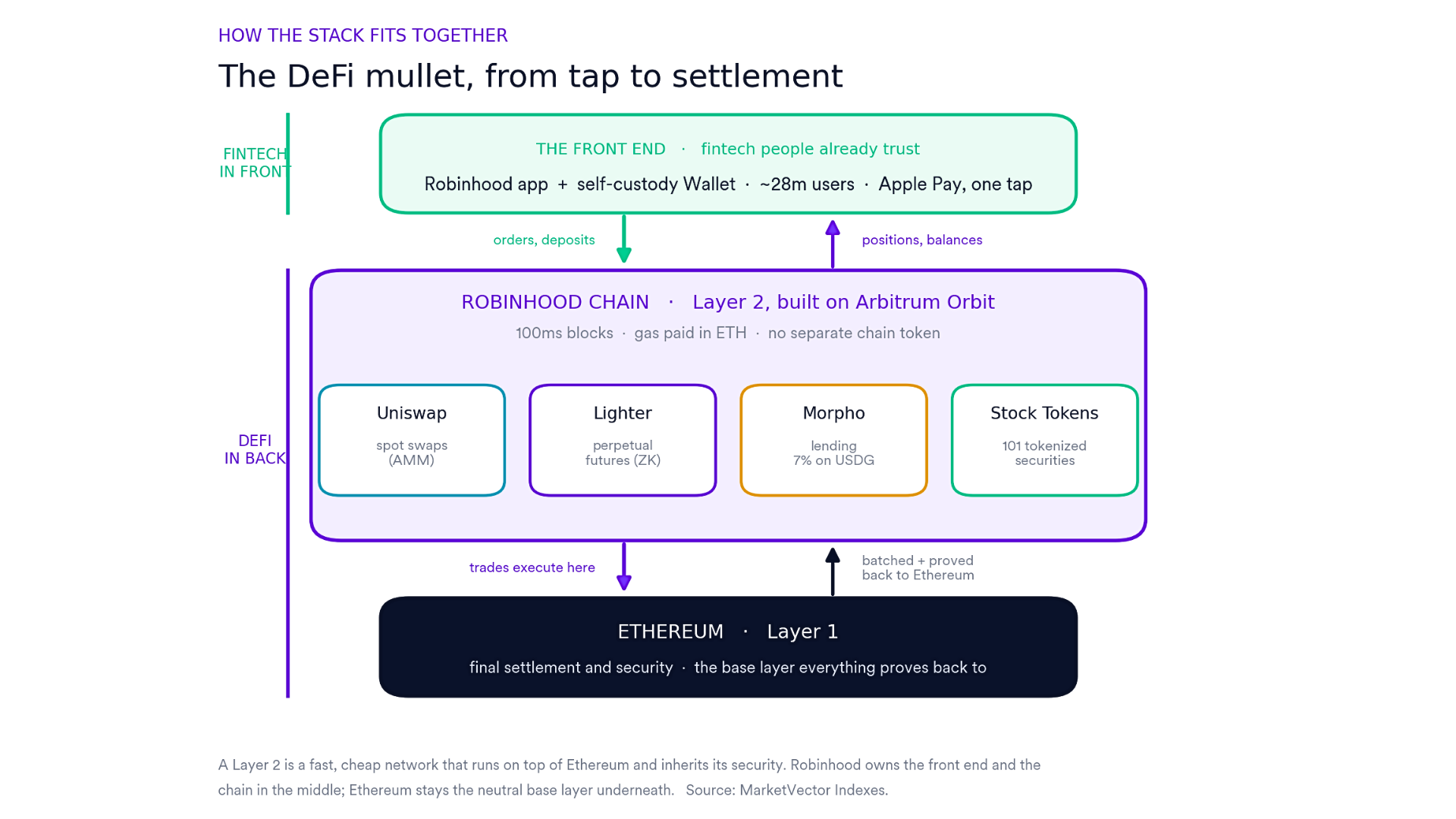
The layered stack the industry nicknames the “DeFi mullet”: fintech in front, decentralized finance in back. Robinhood owns the front end that customers trust and the Layer 2 in the middle where trades happen; Ethereum remains the neutral base layer that everything settles back to. Day-one applications include Uniswap for swaps, Lighter for perpetuals, and Morpho for lending. Source: MarketVector Indexes.
The shape of the thing is simple to describe: fintech in the front, decentralized finance in the back. The customer sees a clean Robinhood screen and taps to fund with Apple Pay. Underneath, open protocols do the swapping, lending, and settling. The complexity is real, but it is hidden.
PLAIN-LANGUAGE GLOSSARY
Layer 1 / Layer 2
Layer 1 is the secure base chain (Ethereum). Layer 2 is a faster network on top that settles back to it.
Rollup
The method a Layer 2 uses to bundle many transactions and post a compressed record to Ethereum.
Sequencer
The service that orders transactions on the Layer 2. Robinhood runs a single one for now, which is fast but centralized.
DEX
A decentralized exchange. Trading runs on public code rather than a company’s internal matching engine.
Perpetual future (“perp”)
A derivative that tracks an asset’s price with leverage and never expires. A very large market offshore.
AMM
An automated market maker: a pool of assets that quotes prices by formula, powering many DEX swaps.
TVL
Total value locked: the capital deposited into a chain’s DeFi apps, a rough gauge of activity.
Stablecoin / USDG
A token pegged to a currency. USDG is the dollar stablecoin used as the settlement asset here.
ZK proof
A cryptographic receipt that proves a computation was done correctly without revealing all its details.
Tokenized stock
An onchain token that tracks a listed share, tradable 24/7. Here structured as a debt token, not equity.
THE ENGINE IN THE BACK
Lighter: what it is & why it’s important
If the chain is the road, Lighter is the high-performance engine Robinhood chose not to build itself. Lighter is a decentralized exchange for perpetual futures, the leveraged, never-expiring contracts that dominate global crypto trading. It runs a genuine order book, the kind professional traders expect, but does so onchain and proves its matching is fair using zero-knowledge cryptography.
Rather than build a derivatives engine in-house, Robinhood wired Lighter directly into the Robinhood Wallet as the native venue for perps. Eligible users in select markets can now open leveraged positions inside a Robinhood surface, with Lighter doing the matching underneath. Perpetuals are not yet available in the United States, the United Kingdom, Canada, Switzerland, and several other jurisdictions, a deliberate, compliance-led rollout rather than a technical limit.
The partnership is not arms-length. Lighter’s founder, Vladimir Novakovski, went to high school with Robinhood’s Vlad Tenev and was an early advisor to the company; Robinhood Ventures backed Lighter’s last raise, a round announced in November that valued the business at about 1.5 billion dollars. That history helps explain an unusually deep integration and, by the founder’s own account, a 50/50 revenue split. Lighter’s half is routed programmatically into buybacks of its LIT token, which turns Robinhood’s retail flow into a direct driver of token value. To seed activity, Lighter has committed about 11 million dollars of LIT to Robinhood users, who earn points at twice the rate when trading through the Wallet.
Why two Lighters are a feature, not a bug
A fair objection is that running a separate Lighter instance for Robinhood fragments liquidity away from Lighter’s main market. The design answer is what the team calls Lighter Domains. The original venue on Ethereum and the Robinhood instance are interoperable: because both sit on Ethereum-based rails, market makers can shift capital between them almost instantly and prove the movement with ZK proofs. A market maker can therefore quote on both books off one balance sheet, which recovers most of the capital efficiency of a single order book while keeping the two markets legally and operationally distinct. That is a meaningfully different situation from bridging between unrelated chains.
There is a subtle risk worth naming. Because tokenized stocks will soon be usable as collateral for perps, and equities do not trade on weekends while the tokens do, prices can dislocate when the underlying market is closed. Lighter prices that risk into the model, charging higher liquidation fees on tokenized securities, in the region of 2.0 to 2.5 percent, than on stablecoin collateral near 1 percent. It is a small detail that signals a serious approach to a real hazard.
WHY THE LIGHTER PIECE MATTERS FOR THE THEME
Lighter is the proof point for a claim we have made for some time: DeFi is becoming the back end for mainstream finance, not a parallel casino beside it. A traditional-looking front end (Robinhood) chose open, verifiable rails (Lighter on Ethereum) because they were simply better technology for the job. The same pattern is now visible in stablecoins, lending, and settlement. When the incumbents adopt the rails, the rails stop being a subculture and start being infrastructure.
THE BUSINESS LOGIC
Why the change happened. Where the money is.
Robinhood already had crypto. What it did not have was ownership of the ledger its customers trade on. Owning the chain changes the economics in four ways, and each maps to a well-understood incentive rather than to crypto idealism.
1. Margin
When a brokerage routes trades through legacy market infrastructure, it rents that infrastructure. When it operates its own chain, the sequencing and settlement it used to pay for become a product it sells. Network fees on Robinhood Chain are running at a gross margin near 99 percent. That is software economics grafted onto a brokerage.
2. Distribution
Robinhood serves nearly 28 million customers across 38 countries. Pointing even a slice of that base at its own rails, with Apple Pay funding and gas fees covered for the first 90 days, is a distribution advantage that few crypto-native platforms can match. Aggregation theory in one sentence: own the user, and you can route the value.
3. Global reach
Self-custody and tokenization let Robinhood offer US-linked assets in more than 120 countries without threading each nation’s brokerage licensing. A tokenized stock trades around the clock and crosses borders in a way a conventional share cannot. This is the literal meaning of “the world is flat.”
4. New monetization layers
The chain stacks fee income, a lending business (Robinhood Earn pays about 7 percent on the USDG stablecoin through Morpho), and a share of derivatives flow via Lighter, on top of the existing brokerage. Idle balances that once sat in a sweep account can now earn onchain.
The timing is not incidental. Robinhood’s crypto revenue fell 47 percent year on year in the first quarter, native crypto volumes roughly halved, and the company trimmed its workforce. A firm facing cyclical pressure in its existing crypto business has every reason to build a structurally higher-margin one underneath it. The move is best understood as diversification away from pure transaction income toward infrastructure and lending, the same logic that led Coinbase to build Base and Stripe to build Tempo.
It is worth being clear-eyed about what powered the first week. A large part of early activity was speculative, including a wave of memecoin trading that Robinhood’s own chief executive openly welcomed as bootstrapping. That is how new networks cold-start. The durable prizes, on our read, are lower operating costs, an onchain margin-lending book, and reaching users in genuinely new markets, not the sequencer fees from any single frantic week.
THE EVIDENCE
The economics of the chain, in four charts
Three conditions have to hold for a new financial network to work: capital has to arrive, that capital has to get used, and the plumbing has to keep up. The launch data shows early progress on all three, from a genuinely tiny base.
Figure 2: From a rounding error to a quarter-million dollars
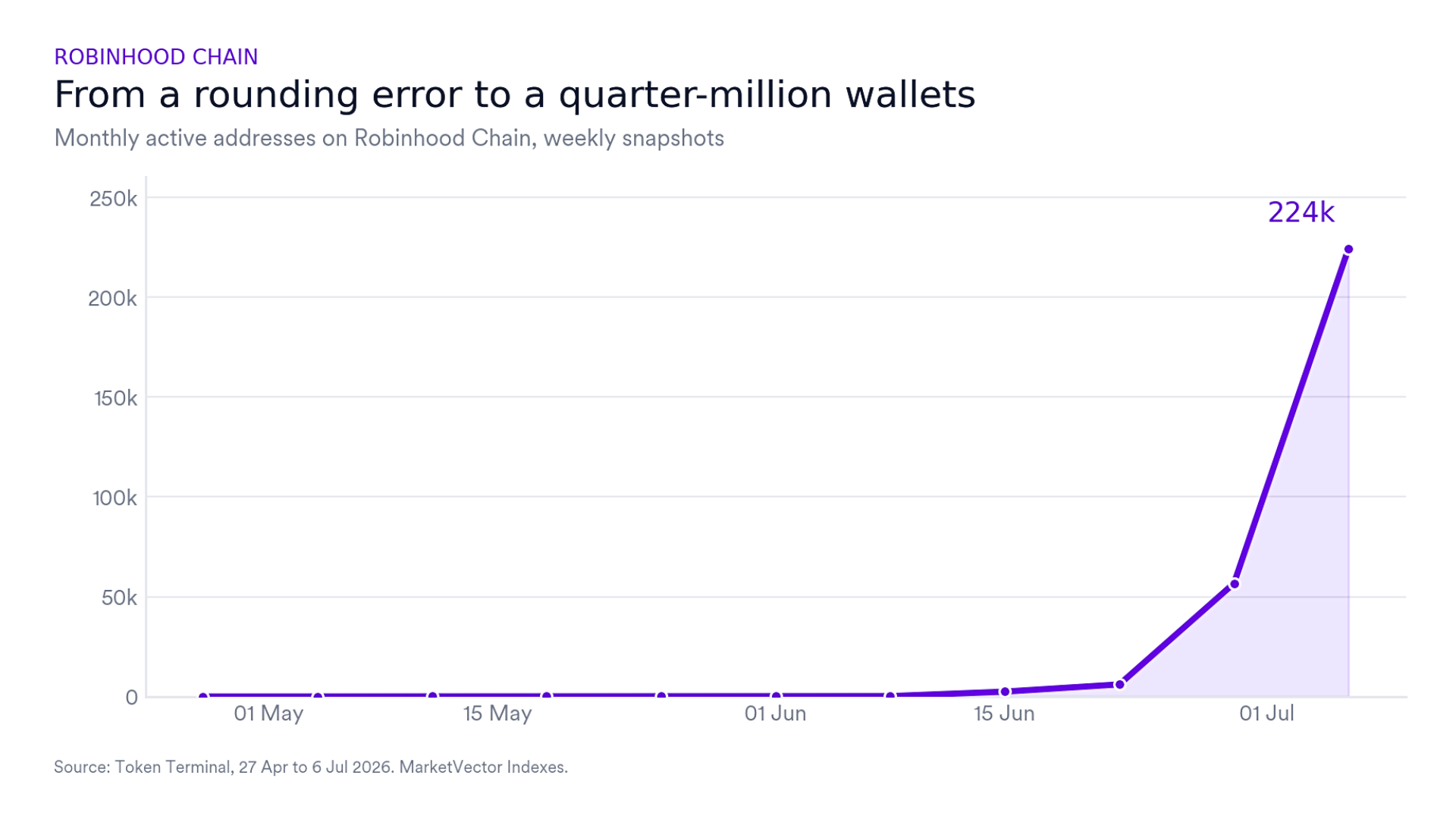
Adoption arrived in a step-change, not a drift. Monthly active wallets went from a handful in late April to roughly 224,000 by the week of 6 July, with the vertical move landing on the 1 July mainnet launch. Source: Token Terminal.
Users only matter if they transact, and transactions only matter if they pay. On both counts the early read is encouraging: revenue expanded faster than users during launch week, which tells us new participants are contributing economic value rather than merely showing up. Weekly network fees climbed from about 100 dollars in mid-May to roughly 16,000 dollars by the end of June, before the launch-week surge pushed cumulative fees past 100,000 dollars.
Figure 3: Fees compound as flow arrives
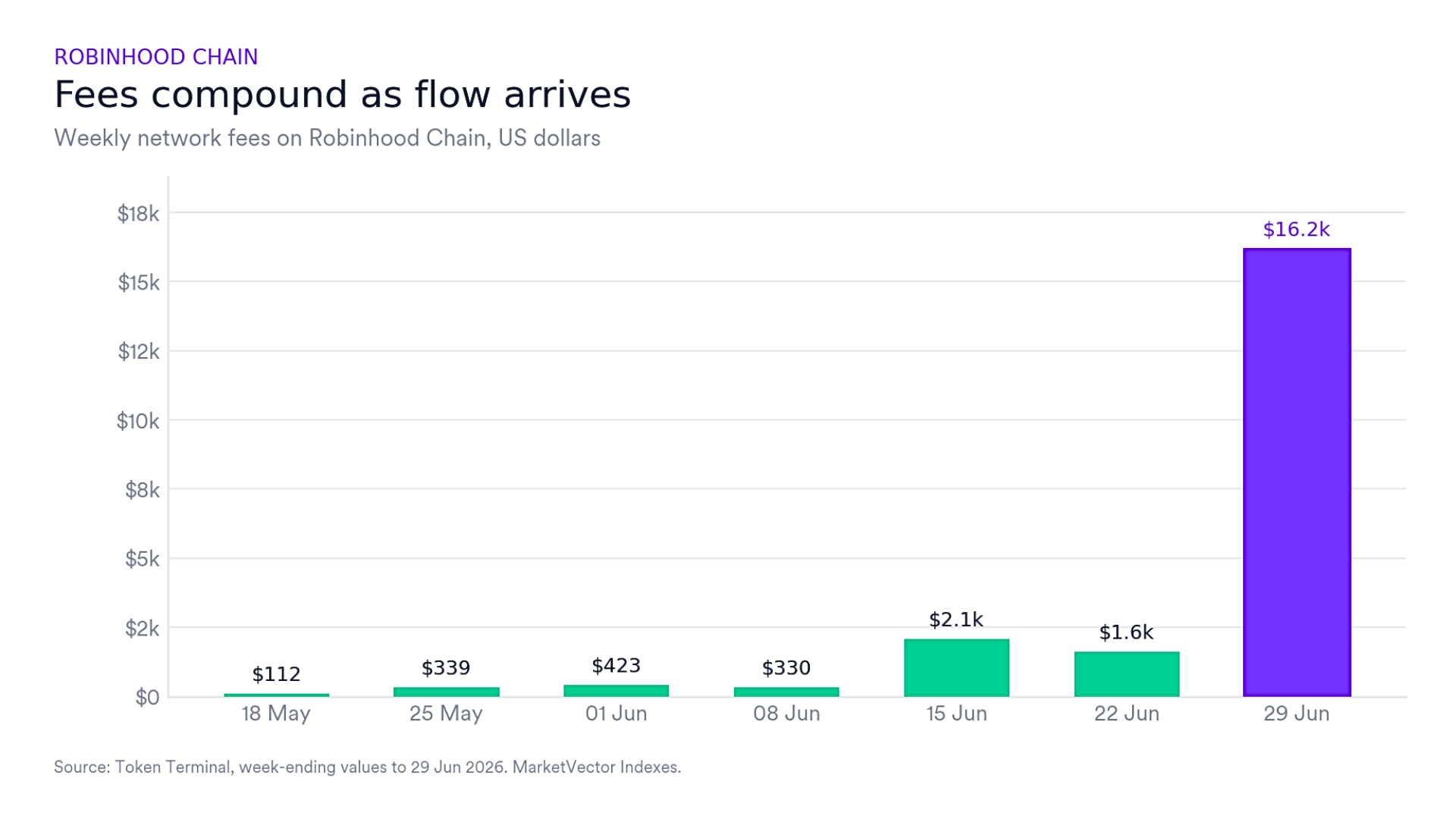
Fees compound as flow arrives. Weekly network fees on Robinhood Chain; the final bar marks the acceleration into launch. Priority fees, a major revenue driver on trading-heavy chains, were not yet switched on. Source: Token Terminal.
Capital did not sit idle either. Within weeks a small but recognisable DeFi stack had assembled on the chain: Uniswap for spot swaps, Morpho and Steakhouse Financial for credit, and Lighter for derivatives. The absolute figures below capture the early build-out, before the July integrations; by launch week, total value locked across the ecosystem had reached roughly 250 million dollars.
Figure 4: A DeFi stack assembles itself
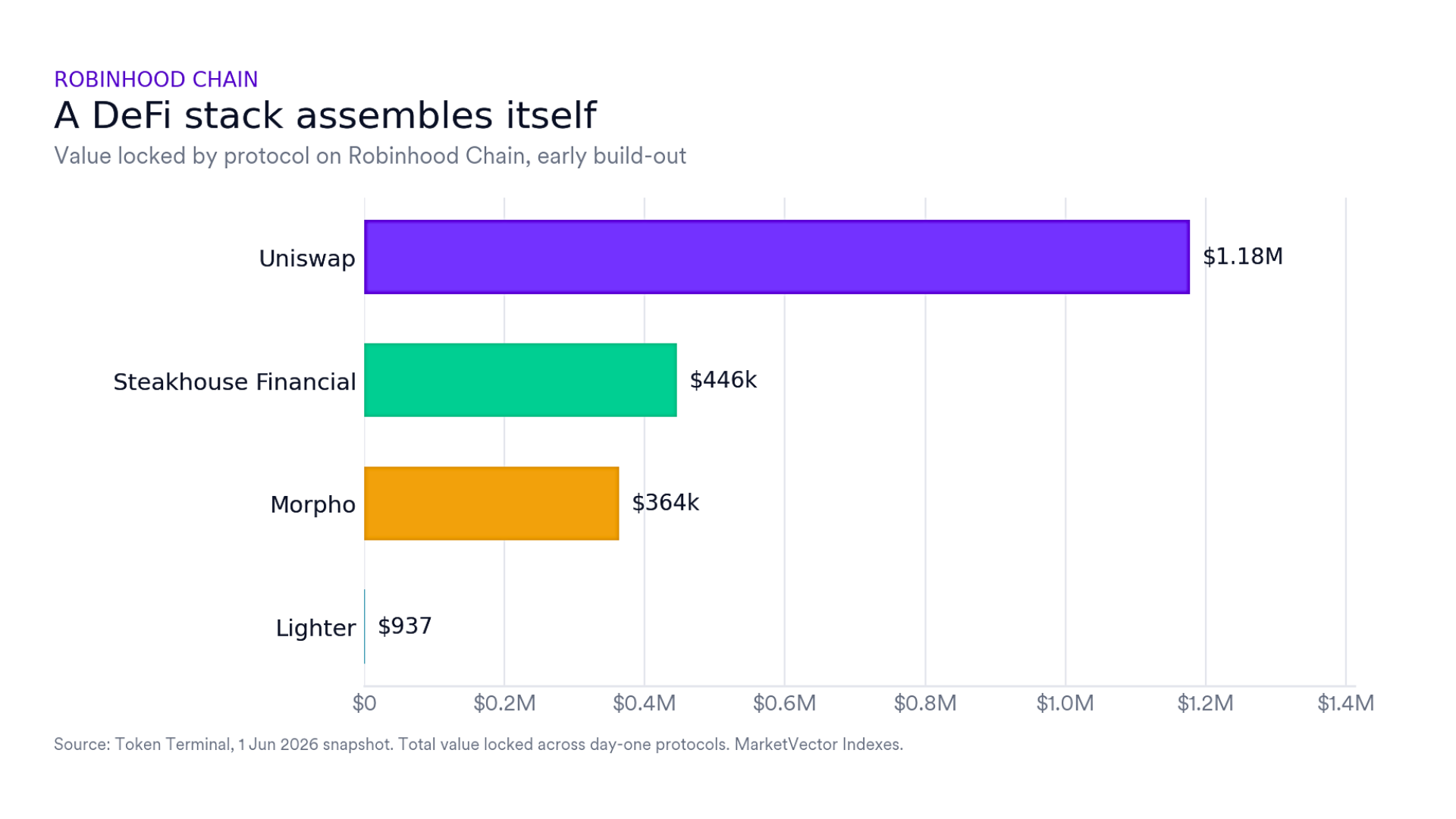
A DeFi stack assembles itself. Value locked by protocol during the early build-out (1 June snapshot), showing the composition of the ecosystem forming on the chain. Launch-week ecosystem TVL reached roughly 250 million dollars. Source: Token Terminal.
Finally, the assets themselves. More than 100 tokenized securities went live in the launch window. The leading names are exactly the stocks a global retail base wants to trade at any hour: chipmakers, mega-cap technology, and a tokenized slice of private companies. A week before this snapshot these tokens were worth tens of dollars each; a week later, hundreds of thousands. That is a launch curve, not a mature market, and we read it as such.
Figure 5: Wall Street, wrapped and onchain
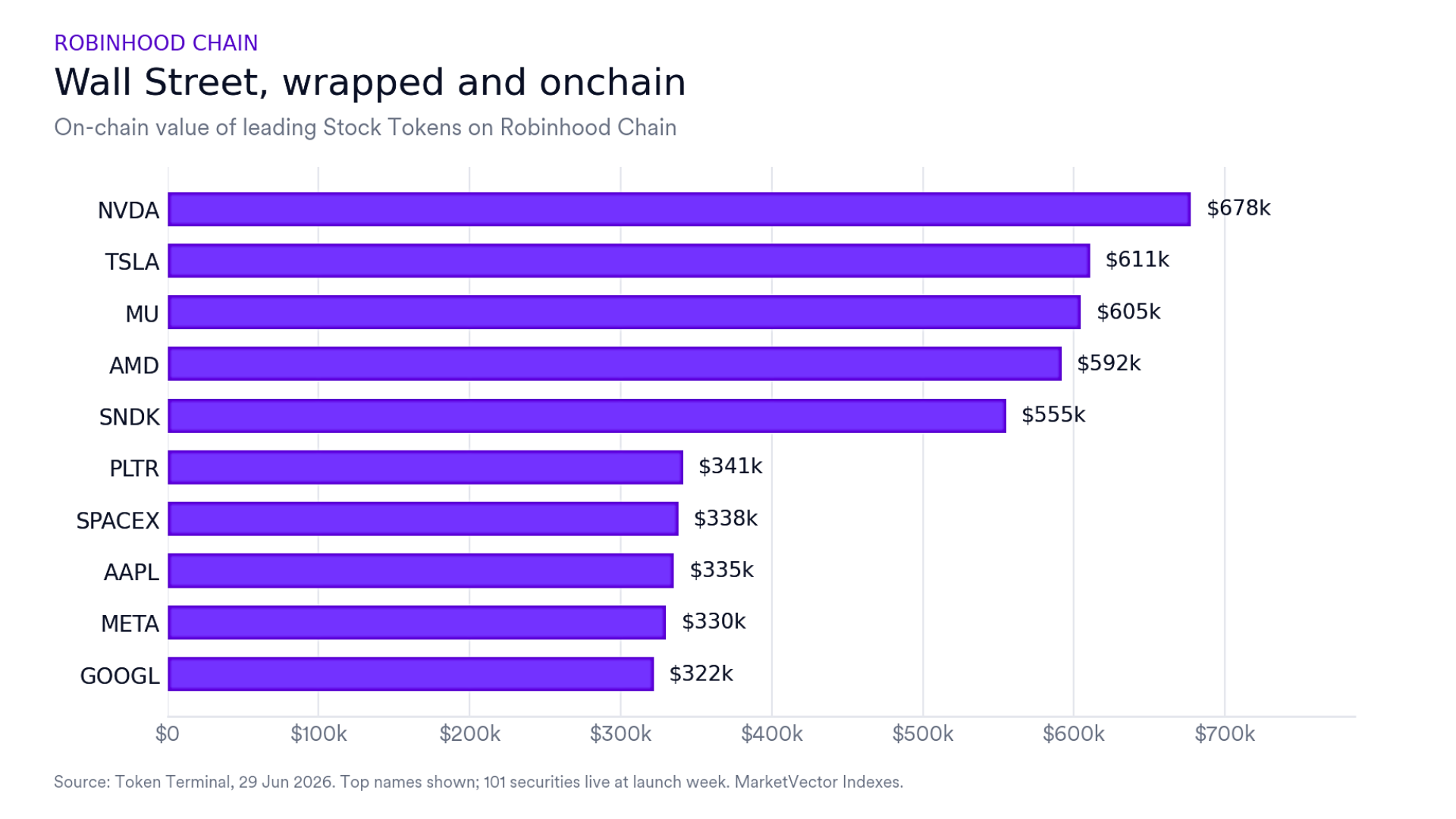
Wall Street, wrapped and onchain. On-chain value of the leading Stock Tokens on Robinhood Chain (29 June snapshot). More than 100 securities were live at launch week. Source: Token Terminal.
None of this proves durability. Block times fell from roughly 580 milliseconds to 100 milliseconds even as daily transactions rose from about 680,000 to 7 million, so the infrastructure has not yet buckled under its own success. Whether the curve holds now depends less on the technology and more on whether Robinhood can keep pulling real assets, applications, and users onto the network.
THE BIGGER PICTURE
How Robinhood’s change foreshadows the future of finance
Strip away the branding and the sea-shanty theatrics of the launch event, and a simple pattern remains: centralized front ends are settling on decentralized rails. That sentence describes Robinhood on Lighter and Ethereum. It also describes Coinbase leaning on Morpho, Stripe building Tempo for payments, and a growing list of fintechs adopting stablecoins because they are simply a better way to move money.
The logic is the same each time. Blockchains are becoming a better system of record for moving and settling value than the batch-based, market-hours plumbing that finance inherited from the last century. Once a firm believes that, the question stops being whether to move activity onchain and becomes whether to let that value flow to someone else’s chain or to capture it on your own. Robinhood, Coinbase, and Stripe have all answered the same way.
Two contests are now underway. The first is between the incumbents themselves. Robinhood Chain and Coinbase’s Base are, in effect, competing to be the primary onchain hub for retail finance, and the winner is likely to be whichever platform best hides the crypto and simply delivers a better product. The two even attract different users: Coinbase’s base of long-term holders lends itself to borrowing against appreciated coins, while Robinhood’s more active, momentum-driven crowd looks more like a high-velocity trading venue. The second contest is quieter and more important: the boundary between a brokerage account and a crypto wallet is dissolving. What remains is a single, always-on, global market for value.
The legacy distinction between “your investing app” and “your crypto wallet” is disappearing. What is left is one place to hold, trade, borrow against, and settle any asset, at any hour, anywhere.
For an index provider, this is the whole game. Convergence is not a slogan we print in a brochure; it is a measurable, investable trend with identifiable beneficiaries. The task is to build a rules-based way to own it. That is what MVTKNQ is.
THE INDEX CASE
Why an Index on Tokenization
We launched MVTKNQ in December 2025 to capture one idea: the tokenization of real-world assets, from Treasuries and private credit to equities, real estate, and commodities, would become core financial infrastructure, and the firms building it would be identifiable in advance. Robinhood’s launch is a live demonstration of that idea, executed by companies the index already holds.
MVTKNQ is a transparent, rules-based index of companies and digital-asset exchange-traded products engaged in the tokenization ecosystem. Constituents are selected for tokenization-related patent leadership or for building tokenized-asset infrastructure, and must derive a majority of revenue from tokenization, digital assets, online brokerage, trading, exchange, financial infrastructure, or adjacent activities. The index pairs an equity sleeve with a 25 to 50 percent allocation to qualifying digital-asset products at each rebalance, so a single holding gives exposure to both the builders and the assets they are bringing onchain.
The Robinhood launch validates the construction on both sides
On the equity side, the index holds the platforms doing exactly what this note describes. Robinhood Markets is a named constituent. So is Coinbase, the operator of the rival Base chain. The index also holds the connective tissue around them: infrastructure and fintech names such as Cloudflare, Block, SoFi, Nu Holdings, and Figure, the kinds of firms that supply the pipes, the payments, and the balance sheets for onchain finance. On the digital-asset side, the ETP sleeve holds exposure to the very networks this activity settles on and consumes, including Ethereum, Solana, XRP, and Chainlink, the oracle layer that prices Robinhood’s Stock Tokens.
Table 1: Representative top constituents as of July 9, 2026. Weights as supplied and subject to periodic rebalance. For illustration; not a recommendation to buy or sell any security.
TOP CONSTITUENTS |
DOMICILE |
WEIGHT |
|---|---|---|
Bitwise Solana Staking ETF |
US |
7.03% |
iShares Ethereum Trust ETF |
US |
6.10% |
Grayscale Chainlink Trust |
US |
5.79% |
Bitwise XRP ETF |
US |
5.67% |
Robinhood Markets Inc, Class A |
US |
1.93% |
Cloudflare Inc, Class A |
US |
1.81% |
Nu Holdings Ltd |
KY |
1.70% |
SoFi Technologies Inc |
US |
1.70% |
Figure Technology Solutions Inc |
US |
1.69% |
Block Inc |
US |
1.68% |
Figure 6: The theme has paid to wait
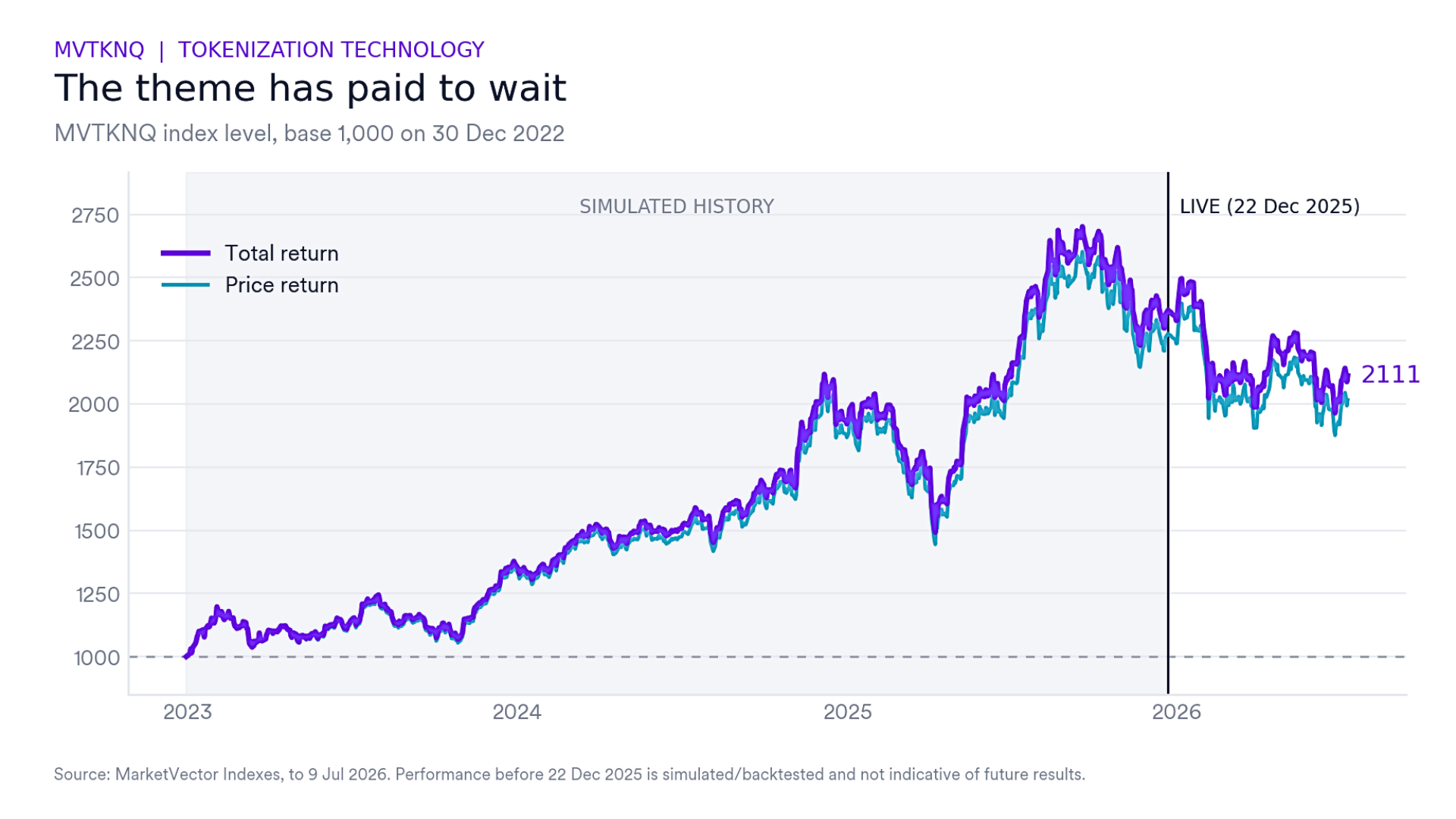
The theme has paid to wait. MVTKNQ index level since a base of 1,000 on 30 December 2022. Performance before the 22 December 2025 live date is simulated and backtested, and is not indicative of future results. Source: MarketVector Indexes, to 9 July 2026.
The construction earns its keep precisely because no one knows in advance which layer of this stack will capture the most value. The chains, the exchanges, the lenders, the oracle providers, and the front-end brokerages are all placing different bets on where the margin will accrue. A rules-based index that spans the equities and the digital assets across that stack does not need to pick the single winner. It needs the theme to be real. Robinhood just spent a keynote, a blockchain, and a partnership arguing that it is.
The Other Side of the Ledger
What we're keeping an eye on
A compelling thesis is not a one-sided one. Several things could slow this transition or change who benefits from it, and a research note that ignored them would not be worth reading.
Centralization under the hood
Robinhood Chain currently relies on a single sequencer, the service that orders transactions. It is fast, but it is a central point of control and a source of concentration risk. The Arbitrum stack offers a documented path to decentralize; until it is walked, this is a company-operated chain wearing a decentralized label.
Regulation is the enabler and the risk
The onshore US opportunity depends on regulatory clarity that does not yet exist. Perpetuals are geofenced out of several major markets, and the path to bringing them onshore runs through the CFTC and pending market-structure legislation. Progress has been constructive, but it is not done, and it is now entangled with politically charged debates.
Revenue durability
Launch-week fees flattered by speculative and memecoin volume are not a run-rate. The more durable prizes, lending economics and lower operating costs, will take quarters to prove. We would treat any annualization of a single week’s sequencer revenue with caution.
Cyclicality and concentration
This launched into a crypto downturn; Robinhood’s own crypto revenue is under pressure. Thematic exposure of this kind is volatile and can be concentrated in a handful of names and networks. The digital-asset sleeve carries the full risk profile of the underlying tokens, and the equity sleeve is sensitive to sentiment on the theme.
Bottom Line
An operating system, not a feature
Robinhood did not just add crypto. It began rebuilding itself on crypto infrastructure, and it invited the rest of the industry to follow. The near-term numbers are small and noisy; the direction is not. Centralized front ends are settling on decentralized rails, the line between a brokerage and a wallet is dissolving, and the firms that own both the customer and the chain are positioned to capture the economics of the transition.
That is the trend MVTKNQ was built to hold. We did not need this launch to make the case for the index. We are simply noting that the market is now making it for us.
About the Author(s):
Martin Leinweber leads digital asset research and strategy at MarketVector Indexes, where he develops index products, publishes institutional research, and serves as the firm's primary voice on crypto markets to a global client base. His work sits at the intersection of systematic investing and an emerging asset class, translating rigorous quantitative frameworks into actionable insight for institutional investors. Before joining MarketVector, Martin spent nearly two decades as a Portfolio Manager across equities, fixed income, and alternative investments. At Quoniam Asset Management, one of Germany's foremost quantitative houses, he managed active funds for institutional clients including insurance companies, pension funds, and sovereign wealth funds. Earlier in his career at MEAG, the asset manager of Munich Re and ERGO, he contributed to the firm's international expansion, including the establishment of a joint venture with PICC, China's largest insurance company, with operations in Shanghai and Beijing. Martin is co-author of two Wiley publications: Asset-Allokation mit Kryptoassets: Das Handbuch (2021), the first institutional handbook on integrating digital assets into traditional portfolios, and Mastering Crypto Assets: Investing in Bitcoin, Ethereum, and Beyond (2024). He holds a Master of Economics from the University of Hohenheim and is a CFA Charterholder.
IMPORTANT DEFINITIONS AND DISCLOSURES
Copyright © 2026 by MarketVector Indexes GmbH (‘MarketVector’) All rights reserved. The MarketVector family of indexes (MarketVectorTM, Bluestar®, MVIS®) is protected through various intellectual property rights and unfair competition and misappropriation laws. MVIS® is a registered trademark of Van Eck Associates Corporation that has been licensed to MarketVector. MarketVectorTM and MarketVector IndexesTM are pending trademarks of Van Eck Associates Corporation. BlueStar®, BlueStar Indexes®, BIGI®, and BIGITech® are trademarks of MarketVector Indexes GmbH.
Redistribution, reproduction, and/or photocopying in whole or in part are prohibited without written permission. All information provided by MarketVector is impersonal and not tailored to the needs of any person, entity, or group of persons. MarketVector receives compensation in connection with licensing its indexes to third parties. You require a license from MarketVector to launch any product that is linked to a MarketVectorTM Index to use the index data for any business purpose and all use of the MarketVectorTM name or name of the MarketVectorTM Index. The past performance of an index is not a guarantee of future results.
It is not possible to invest directly in an index. Exposure to an asset class represented by an index is available through investable instruments based on that index. MarketVector does not sponsor, endorse, sell, promote, or manage any investment fund or other investment vehicle that is offered by third parties and that seeks to provide an investment return based on the performance of any index. MarketVector makes no assurance that investment products based on the index will accurately track index performance or provide positive investment returns. MarketVector is not an investment advisor, and it makes no representation regarding the advisability of investing in any such investment fund or other investment vehicle. A decision to invest in any such investment fund or other investment vehicle should not be made in reliance on any of the statements set forth in this document.
Investments into cryptocurrencies and/or digital assets are subject to material and high risk including the risk of total loss. The calculated prices may not be achieved by investors as the calculated price is based on prices from different trading platforms. Furthermore, an investment into cryptocurrencies and/or digital assets may become illiquid depending on the trading platform or investment product used for the specific investment. Investors should carefully review all risk factors disclosed by the relevant trading platform or in the product documents of relevant investment products.
Prospective investors are advised to make an investment in any such fund or other vehicle only after carefully considering the risks associated with investing in such funds, as detailed in an offering memorandum or similar document that is prepared by or on behalf of the issuer of the investment fund or other vehicle. The inclusion of a security within an index is not a recommendation by MarketVector to buy, sell, or hold such security, nor is it considered to be investment advice.
All information shown prior to the index launch date is simulated performance data created from backtesting ("Simulated past performance”). Simulated past performance is not actual but hypothetical performance based on the same or fundamentally the same methodology that was in effect when the index was launched. Simulated past performance may materially differ from the actual performance. Actual or simulated past performance is no guarantee for future results.
These materials have been prepared solely for informational purposes based upon information generally available to the public from sources believed to be reliable. No content contained in these materials (including index data, ratings, credit-related analyses and data, model, software, or other application or output therefrom) or any part thereof (Content) may be modified, reverse-engineered, reproduced or distributed in any form by any means, or stored in a database or retrieval system, without the prior written permission of MarketVector. The Content shall not be used for any unlawful or unauthorized purposes. MarketVector and its third-party data providers and licensors (collectively “MarketVector Parties”) do not guarantee the accuracy, completeness, timeliness, or availability of the Content. MarketVector Parties are not responsible for any errors or omissions, regardless of the cause, for the results obtained from the use of the Content. THE CONTENT IS PROVIDED ON AN “AS IS” BASIS. MARKETVECTOR PARTIES DISCLAIM ANY AND ALL EXPRESS OR IMPLIED WARRANTIES, INCLUDING, BUT NOT LIMITED TO, ANY WARRANTIES OF MERCHANTABILITY OR FITNESS FOR A PARTICULAR PURPOSE OR USE, FREEDOM FROM BUGS, SOFTWARE ERRORS, OR DEFECTS, THAT THE CONTENT’S FUNCTIONING WILL BE UNINTERRUPTED OR THAT THE CONTENT WILL OPERATE WITH ANY SOFTWARE OR HARDWARE CONFIGURATION. In no event shall MarketVector Parties be liable to any party for any direct, indirect, incidental, exemplary, compensatory, punitive, special, or consequential damages, costs, expenses, legal fees, or losses (including, without limitation, lost income or lost profits and opportunity costs) in connection with any use of the Content even if advised of the possibility of such damages.
Get the latest news & insights from MarketVector
Get the newsletterRelated:
Most popular
-
 Commentary
Hidden GEMs: Monaco
-
 Commentary
Hyperliquid Hits Hyperdrive