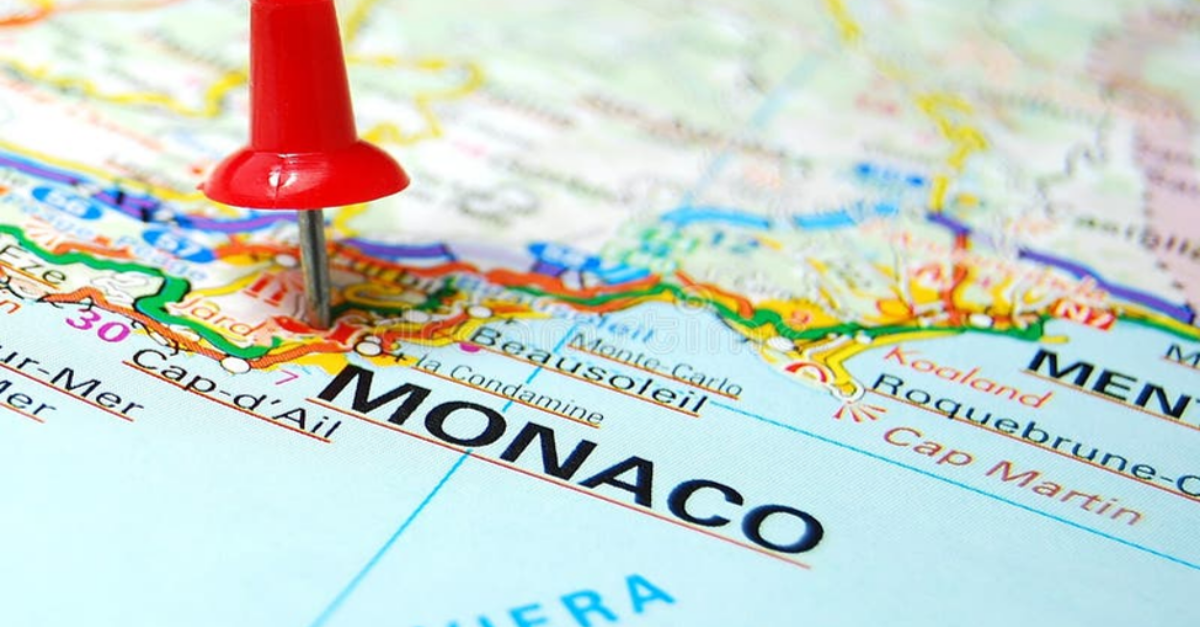
Sitting on the French Riviera, Monaco is the second smallest country on Earth, at roughly 2.02 square kilometers, trailing only Vatican City. At the end of 2025, it had 38,857 residents, with 144 different nationalities. Only about a quarter of residents hold Monégasque nationality, followed closely by French nationals (8,270), Italian nationals (7,559), and British (3,081).
That international makeup follows directly from Monaco's tax regime. Monaco has levied no personal income tax on residents since 1869. There is also no wealth tax, no annual property tax, and no capital gains tax for individuals. French nationals are a notable exception: under a bilateral arrangement dating to the early 1960s, French citizens who cannot prove Monaco residency before October 31, 1962, remain subject to French income tax. A reminder that even a fully sovereign Monaco stays economically tied to its much larger neighbor.
Sector Analysis
Monaco's GDP crossed EUR 10 billion for the first time in 2024, reaching EUR 10.28 billion, real growth of 8.8%. Since 87.5% of Monaco's workforce commutes in from outside, IMSEE (the Institute of Statistics and Economic Studies) calculates GDP per capita against residents plus these non-resident workers, reaching EUR 107,213 in 2024. World Bank figures, based on residents only, put it far higher, at USD 256,581 (for 2023). Either way, these numbers are among the highest in the world.
There is basically no agriculture in Monaco. Industry, including the light manufacturing concentrated in the Fontvieille district, accounts for only about 4.3% of the economy, while services make up the rest.
Scientific and technical activities, administrative and support services are the largest single contributor, at 23.5% of GDP (EUR 2.42 billion). Financial and insurance activities rank second, at 17.6% of GDP (EUR 1.80 billion). Construction overtook wholesale trade in 2024 to become the third-largest sector, at 9.6% of GDP (EUR 984.5 million). Wholesale trade slipped to fourth, at 8.6% of GDP (EUR 879.3 million). Accommodation and food services, the core of Monaco's hospitality sector, reached 8.1% of GDP (EUR 828.8 million). Real estate activities contributed 6.2% of GDP (EUR 635.7 million). Together, the top three sectors, scientific and technical services, financial services, and construction, accounted for just over half of Monaco's GDP in 2024 (50.6%).
Why Monaco Companies Stay Private
Forming a public company in Monaco is deliberately difficult. A société anonyme Monégasque (SAM), the Monaco equivalent of a public limited company, requires the Minister of State's approval of its articles of association and a minimum share capital of EUR 150,000 (higher for financial businesses), compared with just EUR 15,000 for an ordinary private company (SARL).
A second, sharper barrier compounds this. Since 2011, Monaco has required companies to know exactly who owns their shares, banning the old system of anonymous "bearer" shares. This extra burden of handling shareholder data could be one of the reasons the companies in Monaco choose to not get listed. A more recent overhaul of Monaco's company law, finalized in 2025, modernized parts of this system, but it left the core rule in place.
The combined effect is that Monaco has never developed a domestic stock exchange, and it stands alongside Liechtenstein, San Marino, Vatican City, and Andorra on the short list of European sovereign states without one. Almost every company in Monaco is privately held, either family owned or a subsidiary of a larger foreign group. Chambers and Partners' 2025 Corporate M&A guide for Monaco describes the local M&A market as essentially a private equity environment, because there's no domestic exchange and almost no Monaco company is listed anywhere.
Two Listings: Bains de Mer and CFM Indosuez in an Otherwise Private Market
Despite everything above, there are two Monaco-incorporated companies that are publicly listed, and both trade in Paris.
Société des Bains de Mer (RIC: BAIN.PA, ISIN MC0000031187) is the larger and more liquid of the two. Founded in 1863 under a sovereign order from Charles III, it operates Monaco's casinos, including the popular Casino de Monte-Carlo, five luxury hotels, and a significant real estate leasing business. It trades on the main Euronext Paris regulated market. The Government of Monaco holds a controlling 64.21% stake. For fiscal year 2025, SBM reported consolidated revenue of EUR 861 million and net income of EUR 112.8 million.
CFM Indosuez Wealth (RIC: MLCFM.EUA, ISIN MC0010000826) is a wealth management firm and a bank founded in 1922 by the sovereign order from Prince Louis II. It trades on Euronext Access Paris, a far more lightly regulated venue than the main exchange, with shares that have low liquidity.
Figure 1: The stock performance over the past 5 years of the two companies
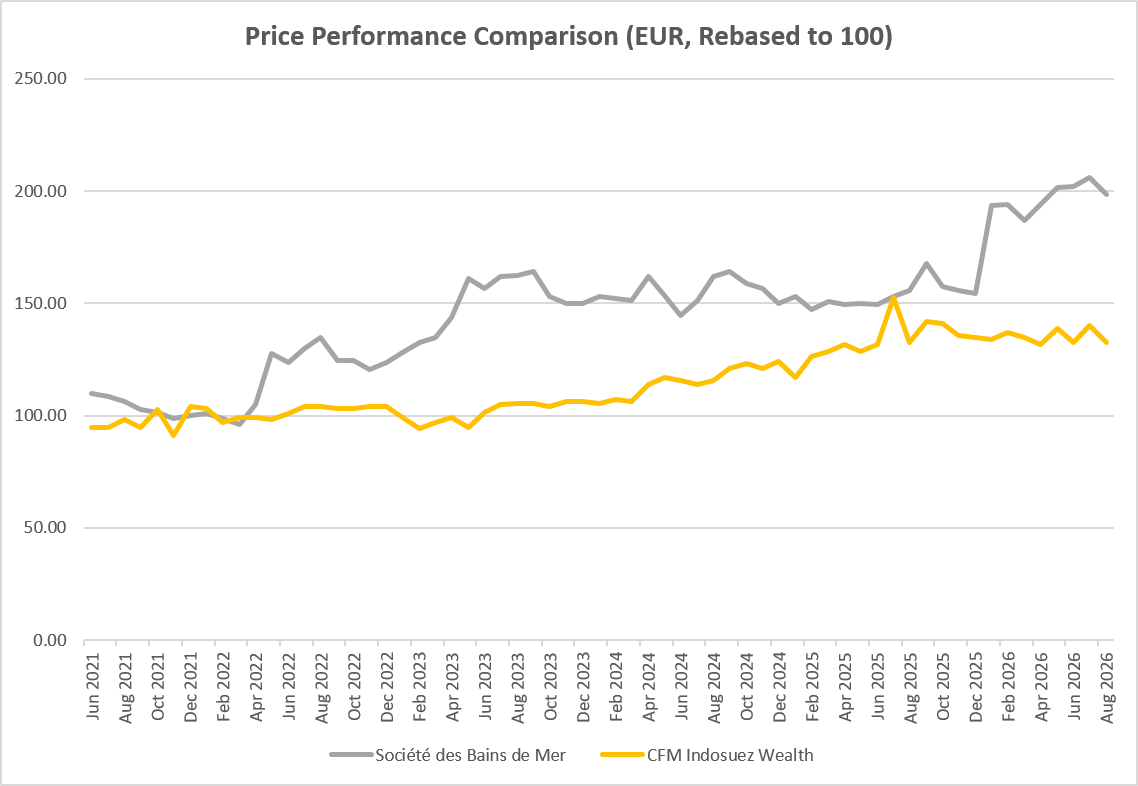
Source: Factset, Rebased to 100 from June 2021 to April 2026.
Under MarketVector's Total Global Equity Index methodology, Société des Bains de Mer is currently the Monaco constituent included in the index.
About the Author(s):
Mohammed Zaid is an Index Specialist at MarketVector Indexes, where he conducts in-depth research, development, and ongoing maintenance of equity indexes. He holds an M.Sc in International Finance from HWR Berlin and has over 3 years of experience with fundamental company analysis and investment research.
For informational and advertising purposes only. The views and opinions expressed are those of the authors but not necessarily those of MarketVector Indexes GmbH. Opinions are current as of the publication date and are subject to change with market conditions. Certain statements contained herein may constitute projections, forecasts, and other forward-looking statements that do not reflect actual results. It is not possible to invest directly in an index. Exposure to an asset class represented by an index is available through investable instruments based on that index. MarketVector Indexes GmbH does not sponsor, endorse, sell, promote, or manage any investment fund or other investment vehicle that is offered by third parties and that seeks to provide an investment return based on the performance of any index. The inclusion of a security within an index is not a recommendation by MarketVector Indexes GmbH to buy, sell, or hold such security, nor is it considered to be investment advice.
Get the latest news & insights from MarketVector
Get the newsletterRelated:
Most popular
-
 Commentary
How Rising Rates Can Impact Equity Returns
-
 Commentary
The Space Economy Is Taking Off